


The SEEED framework™️ is an original, evidence-informed framework developed from both extensive personal experiences, professional practice and critical engagement with interdisciplinary research. SEEED – Self: Engage, Expand, Evolve & Develop – emerged from a sustained recognition that existing approaches to learning and professional development often fall short of integrating the understanding of complex factors influencing human development, relationships and organisational change. In response to these gaps, this framework provides a conceptual foundation that supports reflective and critical enquiry, informed decision making and sustainable development and underpins House of New Thinking’s speaking events, CPD-programmes, masterclasses and other life-long programmes.
The framework is organised into three interconnected stages:
Stage One: Engage
Learning begins with curiosity. This stage encourages engagement with new ideas, perspectives and questions that deepen understanding of self and others. Through reflection and inquiry, this stage explores the experiences, beliefs, behaviours and influences that shape how we learn, relate and respond to the wider environment.
Stage Two: Expand
Building on these foundations, this stage broadens understanding, challenges existing perspectives and encourages critical engagement with social, educational and contextual factors that shape learning, behaviour, opportunity and change.
Stage Three: Evolve & Develop
Learning becomes meaningful when it is applied. This stage focuses on developing the confidence, capability and practical tools to turn understanding into action to strengthen personal, academic and professional development.
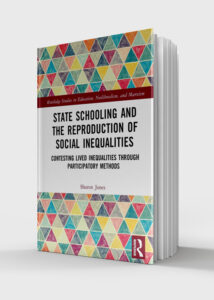
Engage with Sharon’s work and begin to understand the idea behind the building of her framework.
STATE SCHOOLING AND THE REPRODUCTION OF SOCIAL INEQUALITIES
This book critically explores the role of state schooling in the reproduction of social class inequalities in the UK. By uniquely combining critical ethnographic methods with participatory visual research, it foregrounds the experiences and recollections of working class adults in relation to their past schooling.
Buy Now